

What to Know About Strut Replacement — Everestway Guide
Suspension struts handle more abuse than almost any other component in your vehicle. They control ride height, dampen road shock, and keep your tires planted through every turn and pothole. When they fail, the symptoms aren’t subtle — and neither are the consequences for handling and braking performance.
At Everestway, we build struts for daily drivers who need reliable, straightforward replacements. This guide walks through the signs that your struts need replacement, what separates a quality unit from a budget knock-off, and how to approach installation safely. Whether you’re deciding on your next set or just researching what to expect, here’s what matters.
How to Tell When Your Struts Are Failing
The most obvious sign is excessive bouncing after hitting a bump — if your car takes more than one or two oscillations to settle, the damping is gone. You’ll also notice uneven tire wear, especially cupping or scalloping along the tread surface, since worn struts let the tire skip and hop rather than maintain constant road contact.
Handling changes are harder to pin down but just as telling. Nosediving under braking, body roll in turns, or a general floaty feel all point to struts that can’t control suspension travel anymore. Leaking fluid around the strut body is a definitive failure — once the hydraulic seal goes, damping stops entirely.
If you’re replacing one side, replace both on that axle. Mismatched damping between left and right creates unpredictable handling, especially in emergency maneuvers.
What Makes a Quality Strut Assembly
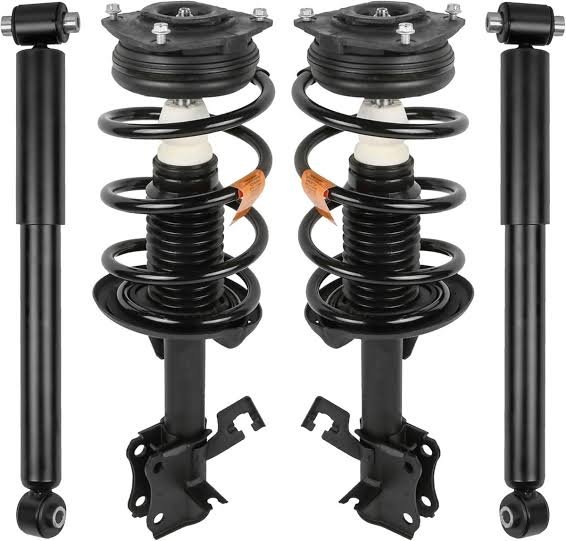
A strut is more than just a shock absorber. It’s a structural component that integrates the damper, coil spring, and often the steering knuckle mount into one assembly. Quality starts with the piston rod material — chromed or nitrided steel resists corrosion and scoring better than bare metal, which extends seal life and prevents fluid leaks.
The damping valves inside the cylinder determine ride quality. Multi-stage valving adjusts damping force based on suspension travel speed, so you get firm control over large bumps without harshness over small road texture. Cheaper units use single-stage valving, which trades comfort for control or vice versa.
Spring and Mount Quality
The coil spring must be rated for your vehicle’s weight and load capacity. Aftermarket springs sometimes sag prematurely if they’re spec’d for the minimum curb weight rather than the realistic loaded weight. The upper strut mount — the bearing assembly that lets the strut rotate with steering input — should include a sealed bearing, not just a rubber bushing. A worn mount causes clunking and steering returnability issues that feel identical to strut failure but aren’t solved by replacing the damper alone.
Are Everestway Struts Good for Daily Driving?
We designed our struts for commuters and weekend road-trippers, not track days or heavy payload work. That means OE-equivalent damping tuned for ride comfort and longevity rather than aggressive handling or load capacity beyond the vehicle’s original spec.
Our assemblies use twin-tube damper construction, which is more forgiving over varied road surfaces than monotube designs but doesn’t handle sustained hard use as well. For a daily driver on public roads, twin-tube gives you a better ride without sacrificing control in normal driving conditions. The spring rates match OE specs, so you’re not lowering or raising the vehicle — just restoring the ride height and damping you had when it was new.
We warrant our struts for 36 months or 36,000 miles, whichever comes first. That coverage assumes proper installation and normal driving conditions. If you tow frequently, haul heavy loads, or drive on consistently rough terrain, the warranty terms note those as exclusions — our units are built for standard road use, not commercial or severe-duty applications.
Installation Safety and Alignment Concerns
Strut replacement involves compressing and releasing coil springs under several hundred pounds of force. A spring compressor failure can launch the spring across a garage or crush a hand against the strut tower. Use only coil spring compressors rated for your spring’s wire diameter and coil count, and always compress the spring evenly from opposite sides — never load one side fully before starting the other.
Once the new strut is installed, the vehicle needs a four-wheel alignment. Removing the strut disturbs the camber and caster angles, and sometimes the toe as well depending on your suspension geometry. Driving on misaligned suspension accelerates tire wear and can pull the vehicle to one side under braking. Safe strut installation means planning for that alignment appointment before you put the car back on the road.
Torque Specs and Fastener Replacement
Strut-to-knuckle bolts and upper mount nuts must be torqued to manufacturer spec. Under-torqued fasteners let the strut shift in its mounts, which creates clunking and accelerates bushing wear. Over-torquing stretches the bolt threads and can crack the strut tower or knuckle. Most strut installations call for 75-100 ft-lbs at the lower mount and 40-50 ft-lbs at the upper, but always verify your specific vehicle’s spec.
Replace any bolt that shows thread damage, corrosion, or elongation. Suspension fasteners are often single-use — the first installation stretches the threads past their elastic limit, and reusing them risks loosening under load.
Choosing the Right Replacement for Your Suspension
Struts wear gradually, so it’s easy to adapt to the decline without realizing how much handling and ride quality you’ve lost. Once you replace them, the difference is immediate — sharper turn-in, better braking control, and a ride that feels planted rather than vague.
We build our struts for drivers who need reliable, straightforward replacements at a fair price. They’re not engineered for track use or heavy-duty work, but for daily commuting and weekend driving, they restore the ride your vehicle was designed to deliver. Match the part number to your year, make, and model, follow torque specs during installation, and get the alignment done before you put serious miles on the new setup.
For more detail on the mechanical steps and tool requirements, the shock absorber engineering overview covers damping principles and common failure modes across different suspension types. If you’re comparing suspension options or planning a full refresh, understanding how struts integrate with the rest of the system helps you make a better choice.
Notes
Under normal driving conditions, our struts are designed to last 50,000 to 70,000 miles before damping performance degrades noticeably. Lifespan varies with road quality, load, and driving style — frequent heavy braking or rough roads shorten it, highway commuting extends it.
The warranty covers 36 months or 36,000 miles, but that’s a defect protection period, not an expected service life. Most drivers will see the struts perform well beyond the warranty window.
Always replace struts in pairs on the same axle. A new strut on one side and a worn strut on the other creates asymmetric damping, which makes the vehicle pull to one side under braking and handle unpredictably in turns.
If your front struts are worn but the rears are still good, you can replace just the front pair. Axle-to-axle differences are normal and don’t cause handling issues the way side-to-side differences do.
Yes. Removing the strut changes camber and caster angles, and sometimes toe depending on your suspension design. Even if the new strut is installed in exactly the same position as the old one, worn bushings and mounts mean that position has likely shifted over time.
Skipping the alignment wears tires unevenly and can make the vehicle pull to one side. Plan for a four-wheel alignment as part of the replacement cost.
A loaded assembly includes the coil spring, upper mount, and bump stop already installed on the strut. A bare strut is just the damper — you reuse your old spring and mount or buy them separately.
Loaded assemblies cost more but save installation time and eliminate the need for a spring compressor, which is the most dangerous part of the job. If your spring or mount is worn, a loaded assembly is the safer and often cheaper option once you factor in the cost of those parts separately.
New struts restore the ride quality you had when the vehicle was new. If your old struts were badly worn, the car probably felt floaty and loose — new struts will feel firmer by comparison because they’re actually controlling suspension movement again.
Our struts use OE-equivalent damping and spring rates, so you’re not changing the ride character, just bringing it back to factory spec. If you want a noticeably stiffer or softer ride, you need performance or comfort-tuned struts with different valving and spring rates.
If you have a coil spring compressor, a torque wrench, and experience working on suspension, you can do it yourself. The hardest part is safely compressing and releasing the coil spring — a mistake here can cause serious injury.
If you’re not set up for it, a shop is the safer choice. Installation labor typically runs one to two hours per axle, and you’ll need the alignment afterward anyway. Factor those costs into your decision before buying parts.